A Note on Context, Corrections, and Verification
Former leadership has stated that while some of the disclosures made on this website contain truth, important context is missing and the resulting narratives are incomplete. They have also explicitly declined to provide the information they believe is missing or to identify specific factual inaccuracies within the materials published here. Instead, they have asked that their personal knowledge of these events simply be trusted.
This website acknowledges that no collection of documents can fully capture every conversation, motive, or perspective surrounding a complex series of events. There are always multiple sides to every story.
However, when the whistleblower initially came forward in 2024, trust alone was not considered sufficient. In written communications, Kidstown leadership stated that:
> "...your anonymity may create limitations to our ability to substantiate action."
To address those concerns, the whistleblower surrendered anonymity, answered extensive questions, and provided contemporary records and supporting documentation. The organization did not simply accept allegations at face value, nor was it asked to do so.
Notably, among the organizations contacted regarding the underlying conduct, Kidstown International was the only organization that indicated anonymity would limit its ability to substantiate action. Other organizations reviewed the information provided without requiring the whistleblower to reveal their identity.
For that reason, this website applies a similar evidentiary standard to claims that its reporting is materially inaccurate. If important context exists, if facts are being misunderstood, or if conclusions are materially incorrect, supporting records and documentation are welcome and will be carefully reviewed.
This website has repeatedly invited Kidstown International, current and former leadership, board members, staff, and others with firsthand knowledge to provide corrections, clarifications, or additional documentation. Readers are encouraged to review the primary source materials, contact Kidstown directly for its perspective, consider all available information, and draw their own conclusions.
Continued Messaging by Jason Vander Kooy After Demand to Stop Contact
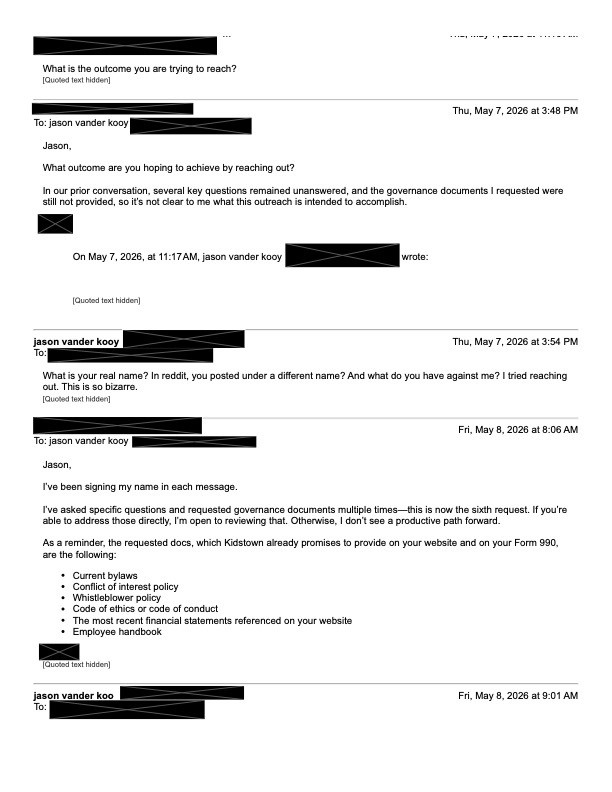
After receiving an explicit written request to cease contact, Vice Chair Jason Vander Kooy continued to initiate email correspondence. Documentation of these exchanges indicates a shift from organizational governance to personal dismissals, including statements that raise significant ethical and privacy concerns when viewed in the context of whistleblower disclosures.
Kidstown International leadership has repeatedly categorized the documentation presented on this platform as “misinformation.” However, despite direct inquiries, the board has failed to identify any specific factual inaccuracies or provide supporting evidence to contradict the primary source materials.
The site contains screenshots, public records, correspondence, timelines, and sourced documentation. Readers are encouraged to review the material, reach their own conclusions, and contact Kidstown International directly if they wish to request the organization’s official perspective.
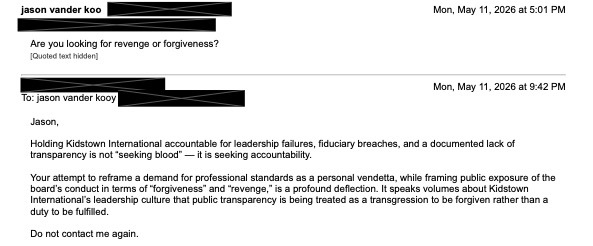

Questionable Transparency in Communications from Kidstown International Vice Chair Jason Vander Kooy
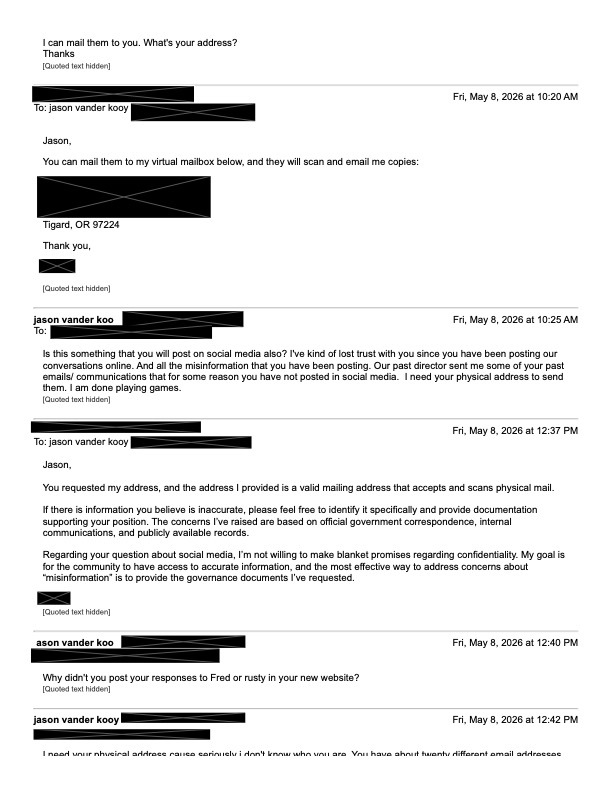
The correspondence from Jason Vander Kooy demonstrates a shift from operational governance to personal dismissals. Gatekeeping public non-profit disclosure documents behind a mandatory demand for a misconduct victim's residential address raises significant ethical and privacy concerns.
The Inquiries Regarding Identity
In recent correspondence, Vice Chair Jason Vander Kooy requested the whistleblower's identity, asking, "What is your real name?" This inquiry directly contradicts the established timeline, as the Vice Chair initiated contact and engaged in a multi-month email exchange with the same individual using their documented name.
The correspondence also references a pseudonym on public forums like Reddit. In modern digital communication, the use of a pseudonym on public platforms is a standard practice for privacy. Throughout all direct correspondence with the former Executive Director and the current Vice Chair, the whistleblower has utilized only their verified legal name and two documented email addresses. The narrative regarding "aliases" is unsupported by the communication logs.
The Requirement of a Residential Address
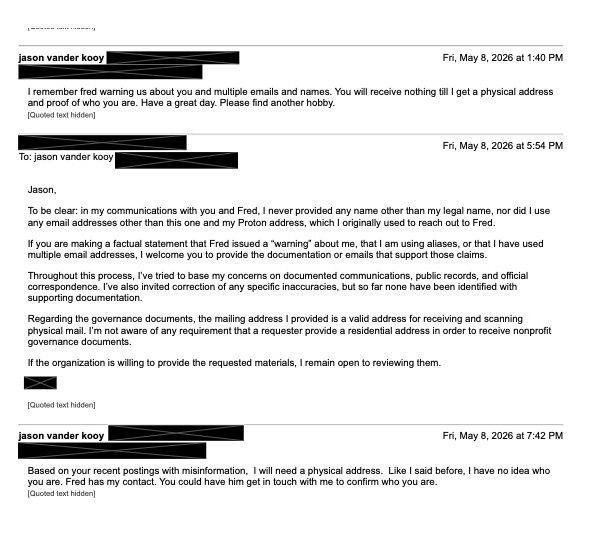
Jason Vander Kooy has repeatedly conditioned the release of mandatory public non-profit governance documents on the provision of the whistleblower's private residential address, despite being provided with a valid, secure corporate mailing address in Tigard, Oregon. The Vice Chair subsequently escalated this requirement by stating that a former director must "confirm" the whistleblower’s identity before public records will be disclosed.
Under state and federal regulations, there is no legal requirement for a member of the public to provide a residential physical address or a personal character reference to access a tax-exempt organization's public disclosures.
Gatekeeping public non-profit records behind a demand for the residential location of an individual who reported organizational misconduct creates significant transparency concerns. In the context of documented grooming and exploitation allegations within the entity's leadership history, demanding a private residential address appears unnecessarily intrusive and acts as an administrative barrier to statutory transparency.
Unsubstantiated Claims Regarding Prior Leadership Warnings
Jason Vander Kooy has also claimed that a former director “warned” the board about this individual allegedly using multiple names and email addresses. When asked to provide evidence supporting that accusation, none was produced.
Attributing unsupported statements to a former leader, one he claims is a personal friend of his, serves as an unbacked attempt to discredit a whistleblower and creates serious credibility and legal concerns. If such a warning actually existed within the organization's records, producing the verifying documentation should be perfunctory.
The Absence of Factual Rebuttals
The board continues to issue broad claims of “misinformation” without addressing the underlying primary evidence, which consists of India-related communications, Romanian government records, public filings, screenshots, and direct written correspondence. The facts follow a simple, undeniable logic:
The India Program: If the communications regarding the misuse of international funds is inaccurate, then Polinder would have lied.
The Romania Program: If the records regarding the closure of the Alsed/Kajántó Mária home are inaccurate, it would require that the official correspondence from the President of the National Authority for the Protection of Children's Rights and Adoption is wrong.
The Identity Claims:
If the allegations regarding multiple false names are accurate, verifying corporate communication logs would exist.
To date, no verifying evidence has been provided by Kidstown International to support their claims or contradict the international government records, screenshots, and direct corporate correspondence made available on this platform. General assertions of inaccuracy without specific factual corrections do not constitute a rebuttal; they serve as administrative distractions.
Furthermore, an operational contradiction exists in the Vice Chair's position: the board asserts it cannot discuss the former Executive Director due to personal relationships, yet simultaneously attempts to weaponize that same unverified relationship to block the public's access to mandatory transparency documents.
The documentation in this section includes:
* India-related communications,
* Romanian government records,
* public records,
* screenshots,
* and direct written correspondence.
According to written communications from Kidstown International’s then Executive Director, Rusty Polinder’s employment was terminated effective September 30, 2024, following the exposure of his behavior and his own admission of misconduct.
Internal documentation indicates that in the year that followed, Rusty Polinder actively lobbied multiple members of Kidstown’s Board for his reinstatement. These communications reveal that board members, having been in contact with him, repeatedly introduced proposals to rehire or re-engage him, resulting in sustained internal pressure on the Executive Director despite the explicit circumstances of the initial termination.
The correspondence demonstrates that this was not an isolated occurrence, but an ongoing issue that persisted for over a year, serving as a recurring source of internal conflict within the organizational leadership.
In November 2025, the then Executive Director confirmed that the documentation provided—including reports and screenshots—served as a critical factor in opposing the reinstatement, underscoring the severity of the underlying conduct.
Direct quotes from the former Executive Director:
“Rusty has convinced multiple members of Kidstown’s Board to lobby me… for his reinstatement.”
“I believe it is imperative to honor your experience, the integrity of our Christian ministry, and all who interface with Kidstown in any way that we do not reinstate Rusty to his position.”
“Everything you have shared is a critical point for me to deny Rusty’s reinstatement.”
“I can no longer be removed as a way to make a pathway for his reinstatement.”
The documentation indicates that the period following the termination resulted in a prolonged internal conflict, ultimately leading to a structural breakdown in executive leadership.
In January 2026, the Executive Director separated from the organization, stating that an “irreconcilable wedge” had developed between the executive office and certain board members as a result of the ongoing pressure to reinstate Polinder. The correspondence indicates that the executive's continuation in the role had become untenable due to the persistent position of the board, which the executive maintained compromised the core integrity of the ministry.
In his final departure communications, the executive explicitly noted his assumption that the board would ultimately move forward with the reinstatement process. The Board Chair also separated from the organization during this exact same period.
*In no way does this website imply the former director supports or is behind this website or its findings.
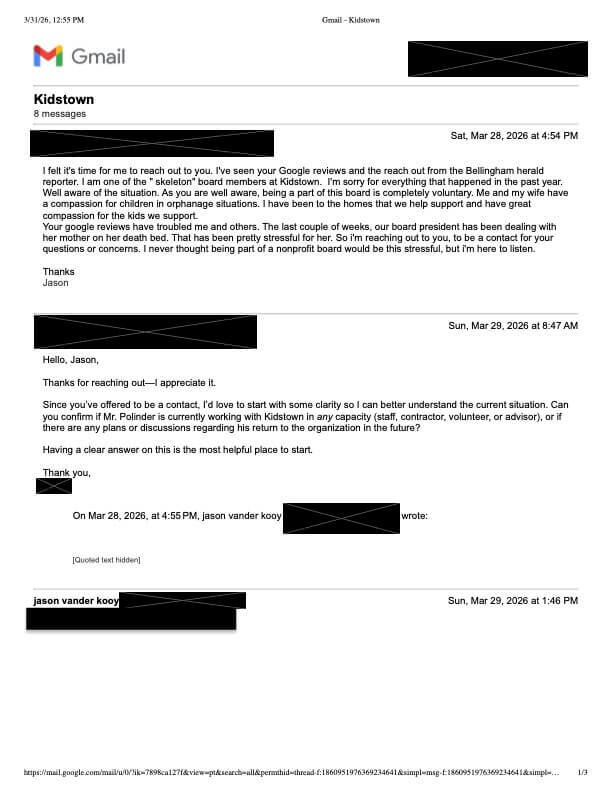
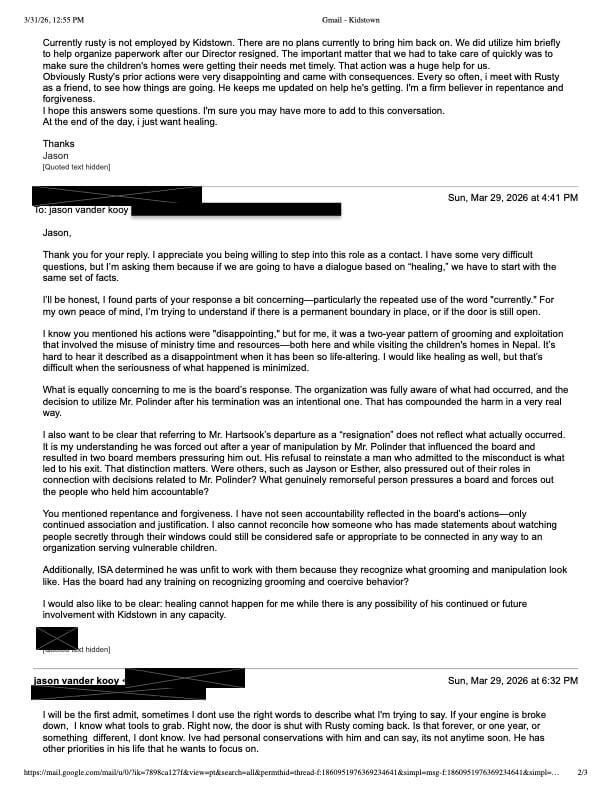
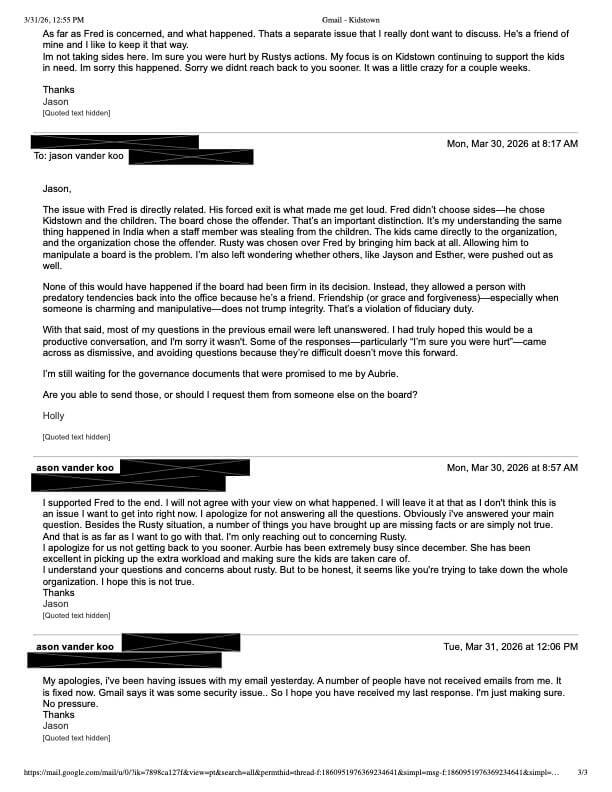
These emails show Jason Vander Kooy, the current Vice Chair, confirming that Rusty was no longer employed, while also acknowledging that Rusty had been briefly brought back to assist with internal work following the Executive Director’s departure. While initially stating there were no plans to reinstate him, he later clarified that the “door is shut” only for now and could change in the future.
The exchange also shows that the board was aware of the misconduct, yet he continued to maintain a personal relationship with Rusty and emphasized forgiveness alongside that acknowledgment. When asked directly about leadership decisions—including the circumstances surrounding the Executive Director’s departure—Jason Vander Kooy declined to engage, stating it was a separate issue.
As the conversation progressed, concerns raised about governance, accountability, and decision-making were characterized as “missing facts” or framed as an attempt to take down the organization, rather than being substantively addressed.
The communications below provide the relevant exchanges and allow readers to review the discussion directly and in context.